
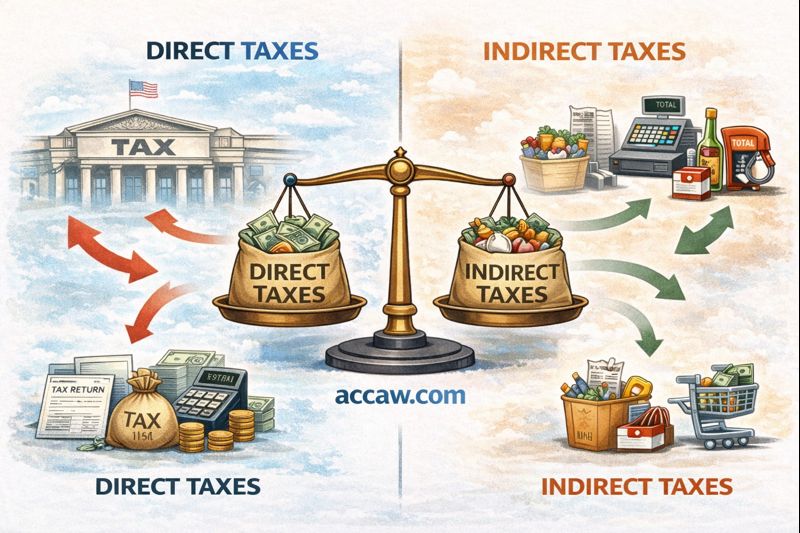
Taxes are a fundamental source of revenue for governments worldwide. This article provides a clear overview of the main types of taxes, their classifications, and how they differ from an accounting perspective—without focusing on any specific country.

Introduction

Taxes play a crucial role in financing public services such as healthcare, education, infrastructure, and security. From an accounting and financial perspective, understanding the main types of taxes helps ensure accurate reporting and better decision-making.

This article provides a global overview of taxation concepts without focusing on any specific country.

1) Direct Taxes vs Indirect Taxes

Direct Taxes

Direct taxes are paid directly by individuals or entities to the tax authority, and the burden typically cannot be shifted to another party.

  • Examples: Income Tax, Corporate Tax, Property Tax

Indirect Taxes

Indirect taxes are collected by businesses but are ultimately borne by consumers through prices of goods and services.

  • Examples: VAT, GST, Sales Tax, Excise Duties

2) Income Tax

Income tax is levied on the income earned by individuals (and sometimes unincorporated businesses). It may be calculated using progressive or proportional rates depending on the jurisdiction.

Accounting note: Income tax is generally personal, but businesses may handle payroll-related tax withholding as part of compliance processes.

3) Corporate Tax

Corporate tax is imposed on taxable profits of companies. It often requires adjustments between accounting profit and taxable profit.

  • Taxable profit vs accounting profit
  • Allowable vs non-allowable expenses
  • Current tax expense and possible deferred tax concepts

Accounting note: corporate tax may require recognition of current tax and, where applicable, deferred tax based on temporary differences.

4) VAT / GST / Sales Tax

VAT (Value Added Tax) and GST (Goods and Services Tax) are forms of indirect tax collected at each stage of the supply chain. Sales tax is typically collected at the final sale to the consumer (depending on the model used).

  • VAT/GST: charged on outputs, recovered on inputs (subject to rules).
  • Sales tax: usually collected once at the retail stage.

Accounting note: VAT/GST is generally a balance sheet item (input recoverable / output payable) and does not form part of revenue or expense (except in special cases where not recoverable).

5) Withholding Tax (WHT)

Withholding tax is deducted at source on certain payments (e.g., dividends, interest, royalties, service fees). The payer withholds and remits the tax to the authority, and the recipient receives the net amount.

  • Purpose: improve collection and reduce non-compliance
  • Common areas: cross-border payments and investment income

6) Excise Taxes

Excise taxes are levied on specific goods such as fuel, tobacco, alcohol, or environmentally harmful products. They are typically charged per unit or as a percentage of value.

Accounting note: excise taxes may be included in inventory cost and cost of sales depending on how the tax is incurred and recoverability rules.

7) Property and Wealth Taxes

These taxes relate to ownership or transfer of assets (e.g., property tax, land tax, inheritance/estate taxes where applicable).

  • Property tax: recurring charge linked to ownership
  • Transfer taxes: may apply when assets are sold/transferred

Accounting note: property taxes are usually operating costs; transfer taxes may be capitalized depending on the asset and the nature of the transaction.

8) Customs Duties

Customs duties are imposed on imports (and sometimes exports). They affect the landed cost of inventory and can influence pricing and profitability.

Accounting note: import duties are commonly included in inventory cost (IAS 2) and recognized in cost of sales when the inventory is sold.

Conclusion

Although tax regulations vary by jurisdiction, the key types and concepts are globally consistent. A strong conceptual understanding supports better accounting, compliance, and reporting.

Share this page: Twitter Facebook LinkedIn