VAT/GST is an indirect tax collected by businesses on behalf of the tax authority. This article explains input VAT vs output VAT, key journal entries, and how VAT appears in financial statements—using an international accounting approach.

1) What is VAT / GST in accounting?

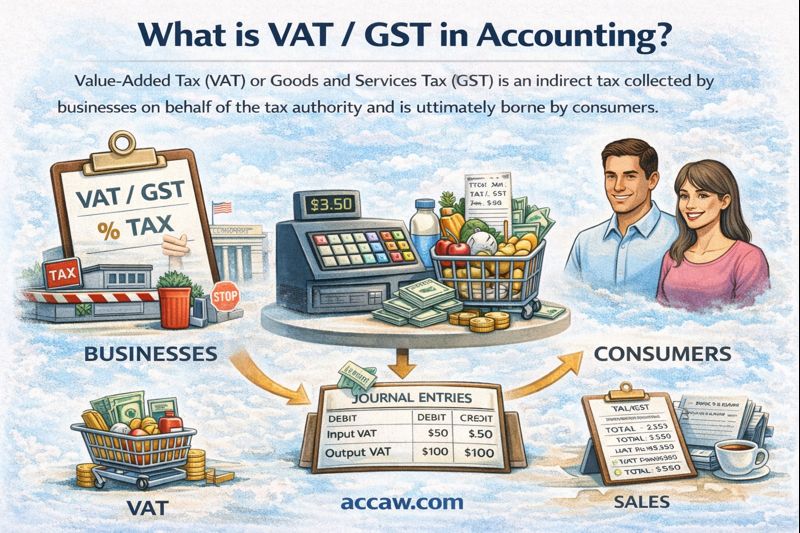
VAT/GST is an indirect tax collected by businesses on behalf of the tax authority. In most systems, the business:

  • Charges VAT/GST on sales (Output VAT)
  • Pays VAT/GST on purchases (Input VAT)

The net amount (Output − Input) is typically paid to or refunded from the tax authority.
2) Key accounts: Input VAT vs Output VAT

  • Input VAT: VAT paid on purchases (often recorded as a recoverable asset if claimable).
  • Output VAT: VAT charged on sales (often recorded as a liability).

Important: VAT is usually not part of revenue or expense (it’s collected/paid on behalf of the authority), unless it is non-recoverable.

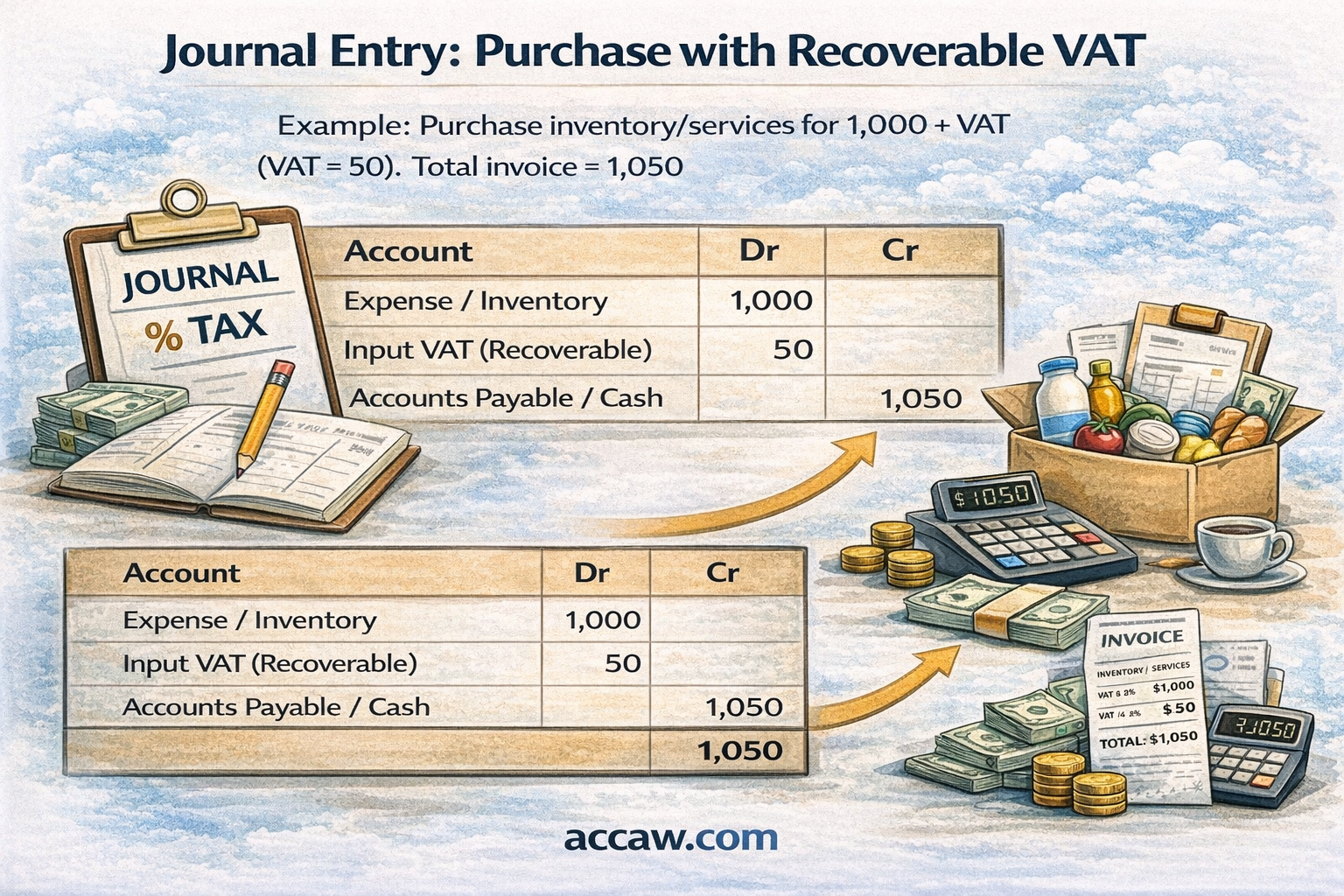
3) Journal entry: Purchase with recoverable VAT

Example: Purchase inventory/services for 1,000 + VAT 5% (VAT = 50). Total invoice = 1,050.

AccountDrCr
Expense / Inventory1,000
Input VAT (Recoverable)50
Accounts Payable / Cash1,050

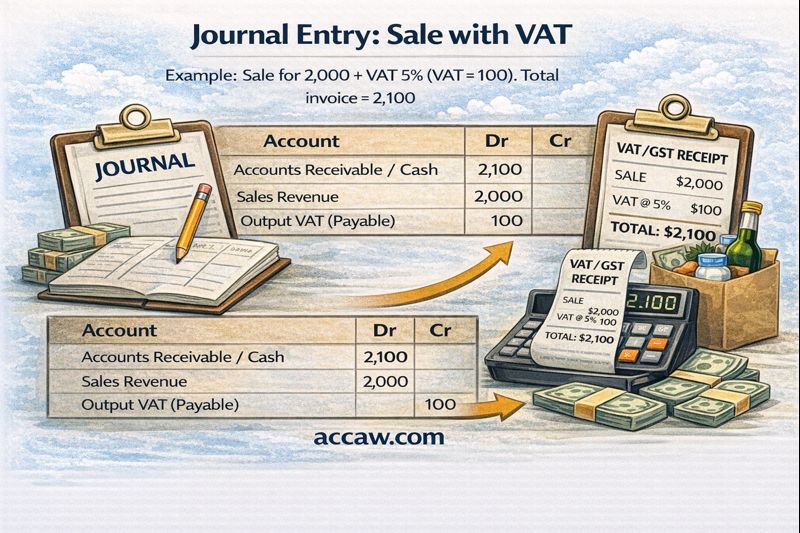
4) Journal entry: Sale with VAT

Example: Sale for 2,000 + VAT 5% (VAT = 100). Total invoice = 2,100.

AccountDrCr
Accounts Receivable / Cash2,100
Sales Revenue2,000
Output VAT (Payable)100

5) VAT return: net payable or refundable

At period end, businesses typically offset Input VAT against Output VAT:

  • If Output VAT > Input VAT → Net VAT payable (liability)
  • If Input VAT > Output VAT → Net VAT refundable (asset)

Some systems use a single “VAT Control” account; others keep Input/Output separate and net them for reporting.

6) Non-recoverable VAT (important exception)

If VAT is not recoverable (due to restrictions, exempt activities, documentation issues, etc.), it becomes part of the cost of the related asset/expense.

Example: Expense 1,000 + VAT 50 (non-recoverable):

AccountDrCr
Expense / Inventory (including VAT) 1,050
Accounts Payable / Cash 1,050

Common mistakes

  • Including VAT in revenue/expense (when recoverable).
  • Using wrong tax rate on invoices.
  • Claiming input VAT without proper invoice/support.
  • Mismatching VAT timing (invoice vs payment rules depending on system).
Share this page: Twitter Facebook LinkedIn