
What are planning budgets? What are their types (operational, capital)?
Budgeting
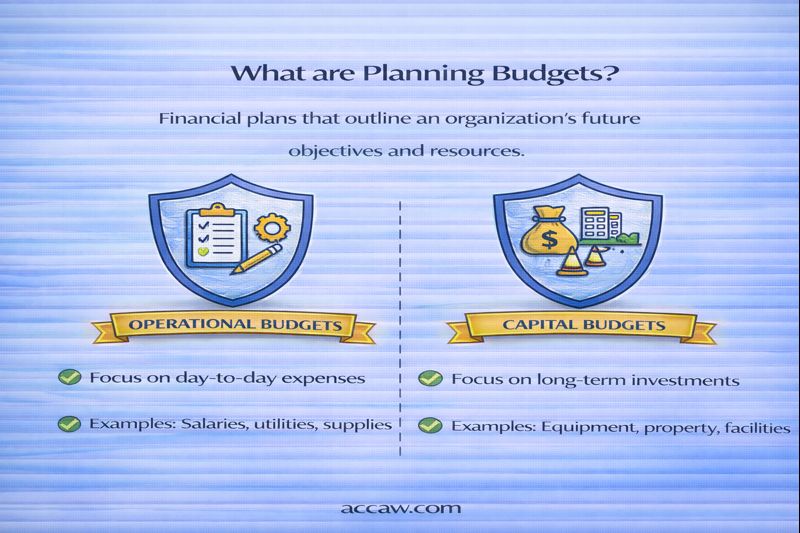
What are planning budgets? What are their types (operational, capital)?
Summary: Planning budgets (or simply budgets) are quantitative financial plans for a future period, expressing management's objectives in monetary terms. The two primary types are: 1) Operating Budgets – detailed plans for all income-generating activities (sales, production, expenses) typically for one year; and 2) Capital Budgets – plans for acquiring long-term assets (property, plant, equipment) and major projects, often spanning multiple years. Together, they form the master budget.
Blueprints for Financial Success
Budgets translate strategic goals into actionable financial targets. They are essential tools for planning, coordination, communication, motivation, and control within an organization.
1. Operating Budgets: The Short-Term Game Plan
The operating budget is a comprehensive plan for all operational activities over the next fiscal year, usually broken down into quarters or months.
Key Components (Prepared in Sequence):
- Sales Budget: The foundation – forecast of sales volume and revenue.
- Production Budget: How many units to produce to meet sales and inventory goals.
Required Production = Budgeted Sales + Desired Ending Inventory - Beginning Inventory
- Direct Materials Budget: Quantity and cost of raw materials needed.
- Direct Labor Budget: Labor hours and cost required.
- Manufacturing Overhead Budget: All anticipated indirect manufacturing costs.
- Ending Finished Goods Inventory Budget.
- Selling & Administrative (S&A) Expense Budget: Forecast of all non-manufacturing expenses.
- Budgeted Income Statement: The culmination, showing expected profit/loss.
Purpose:
- Plan and coordinate sales, production, and support activities.
- Set targets for revenue and cost control.
- Provide a benchmark for performance evaluation (variance analysis).
2. Capital Budgets: The Long-Term Investment Plan
The capital budget outlines plans for significant investments in long-term assets and major projects that will generate benefits over many years.
Key Characteristics:
- Time Horizon: Multi-year (3, 5, 10 years).
- Focus: Strategic investments (new machinery, buildings, technology systems, R&D projects, acquisitions).
- High Value & Irreversibility: Decisions are critical due to large outlays and long-term commitment.
Capital Budgeting Evaluation Techniques (used to approve projects):
- Net Present Value (NPV): Sum of present values of future cash flows minus initial investment. Accept if NPV > 0.
- Internal Rate of Return (IRR): The discount rate that makes NPV = 0. Accept if IRR > required rate of return.
- Payback Period: Time to recover the initial investment. Shorter is better, but ignores time value of money.
- Profitability Index (PI): Present value of future cash flows / Initial investment. Accept if PI > 1.
Purpose:
- Plan for future growth and capacity.
- Allocate scarce capital resources to the most profitable projects.
- Ensure long-term strategic alignment.
3. The Master Budget: Bringing It All Together
The Master Budget is the comprehensive financial plan that integrates both the operating and capital budgets, along with the financial budgets (cash budget, budgeted balance sheet).
Master Budget Includes:
1. Operating Budgets (as listed above).
2. Capital Budget.
3. Cash Budget: Forecast of cash inflows/outflows to ensure liquidity.
4. Budgeted Balance Sheet: Projects the financial position at the end of the period.
5. Budgeted Statement of Cash Flows.
4. Importance of Budgeting
- Planning: Forces management to think ahead and set goals.
- Coordination: Ensures all departments work towards common objectives (e.g., production aligns with sales forecasts).
- Communication: Clearly communicates expectations throughout the organization.
- Motivation: Can motivate employees if budget targets are challenging but achievable.
- Control: Serves as a benchmark to compare actual results (variance analysis), enabling corrective action.
- Performance Evaluation: Used to evaluate managerial performance.
5. Conclusion: A Dynamic Management Tool
Planning budgets are not static documents but dynamic management tools. Operating budgets keep the business running efficiently day-to-day, while capital budgets secure its future growth and competitiveness. Together, they enable an organization to navigate from its current position to its desired future, balancing short-term operational needs with long-term strategic investments.