
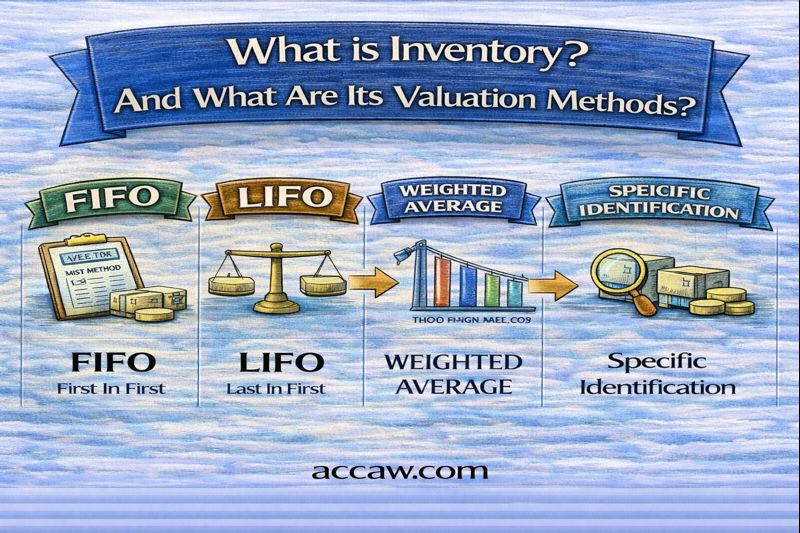
Inventory refers to goods held for sale or production. Valuation methods include FIFO, LIFO, Weighted Average, and Specific Identification, affecting cost of goods sold and ending inventory values.

What is Inventory?

Inventory refers to goods that a company holds for sale in the ordinary course of business, or materials used in production of goods for sale.

Types of Inventory:

  1. Raw Materials: Basic materials for production
  2. Work-in-Progress: Partially completed goods
  3. Finished Goods: Completed products ready for sale
  4. Merchandise: Goods purchased for resale

Inventory Importance:

  • Major current asset for many companies
  • Affects cost of goods sold and profit
  • Impacts cash flow and working capital
  • Subject to theft, damage, obsolescence

Inventory Valuation Methods

1. FIFO (First-In, First-Out)

Assumes oldest inventory sold first.

  • Effect in inflation: Lower COGS, higher ending inventory, higher profit
  • Balance sheet: Inventory at recent prices
  • Example: Sell oldest items first
  • Allowed: Both GAAP and IFRS

2. LIFO (Last-In, First-Out)

Assumes newest inventory sold first.

  • Effect in inflation: Higher COGS, lower ending inventory, lower profit
  • Balance sheet: Inventory at older prices
  • Example: Sell newest items first
  • Allowed: GAAP only, not IFRS

3. Weighted Average Cost

Average cost of all units available.

  • Calculation: Total cost ÷ Total units
  • Effect: Smooths price fluctuations
  • Example: All units at average price
  • Allowed: Both GAAP and IFRS

4. Specific Identification

Track cost of each specific item.

  • Use: High-value, unique items
  • Examples: Cars, jewelry, custom furniture
  • Required: For items not interchangeable
  • Allowed: Both GAAP and IFRS

Practical Examples and Calculations

Sample Data:

  • Beginning inventory: 100 units @ $10 = $1,000
  • Purchase 1: 200 units @ $12 = $2,400
  • Purchase 2: 150 units @ $15 = $2,250
  • Total available: 450 units, total cost $5,650
  • Sold: 300 units
  • Ending inventory: 150 units

FIFO Calculation:

  1. COGS: 100 @ $10 + 200 @ $12 = $1,000 + $2,400 = $3,400
  2. Ending inventory: 150 @ $15 = $2,250

LIFO Calculation:

  1. COGS: 150 @ $15 + 150 @ $12 = $2,250 + $1,800 = $4,050
  2. Ending inventory: 50 @ $12 + 100 @ $10 = $600 + $1,000 = $1,600

Weighted Average Calculation:

  1. Average cost per unit: $5,650 ÷ 450 = $12.56
  2. COGS: 300 × $12.56 = $3,768
  3. Ending inventory: 150 × $12.56 = $1,882

Comparison Summary:

MethodCOGSEnding InventoryGross ProfitTax Effect
FIFO$3,400$2,250HighestHigher tax
LIFO$4,050$1,600LowestLower tax
Weighted Avg$3,768$1,882MiddleMiddle

Specific Identification Example:

  • Car dealership: Track each car separately
  • Car A: Cost $20,000, sold for $25,000
  • Car B: Cost $22,000, still in inventory
  • COGS for Car A: $20,000
  • Ending inventory: $22,000 (Car B)

Important Considerations:

  1. Consistency: Use same method consistently
  2. Disclosure: Must disclose method used
  3. Physical Flow: Method may not match actual physical flow
  4. Tax vs Book: Different methods may be used for tax and financial reporting
  5. LIFO Conformity Rule: If use LIFO for tax, must use for financial reporting (US)
  6. Inventory Layers: LIFO creates layers of inventory at different costs

Choosing a Method:

Use FIFO When:

  • Want to show higher profits
  • Inventory prices stable or decreasing
  • Following IFRS (LIFO not allowed)
  • Perishable goods (actual flow matches)

Use LIFO When:

  • Want tax savings in inflation
  • Prices rising consistently
  • In US under GAAP
  • Matching current costs with current revenues

Use Weighted Average When:

  • Prices fluctuate frequently
  • Items not distinguishable
  • Want to smooth profit fluctuations
  • Simpler calculations desired

Use Specific Identification When:

  • High-value, unique items
  • Each item has different cost
  • Easy to track individual items
  • Required by nature of items

Financial Statement Impact:

  • Income Statement: Affects COGS and gross profit
  • Balance Sheet: Affects inventory asset value
  • Ratios: Affects current ratio, inventory turnover
  • Cash Flow: Indirect effect through taxes

Key Points to Remember:

  1. Method choice affects reported profit and taxes
  2. Must be consistent in application
  3. LIFO not allowed under IFRS
  4. Specific identification required for unique items
  5. Physical count required periodically
  6. Disclose method and any changes
Share this page: Twitter Facebook LinkedIn