
What is the difference between International Financial Reporting Standards (IFRS) and US Generally Accepted Accounting Principles (US GAAP)?
Accounting Standards
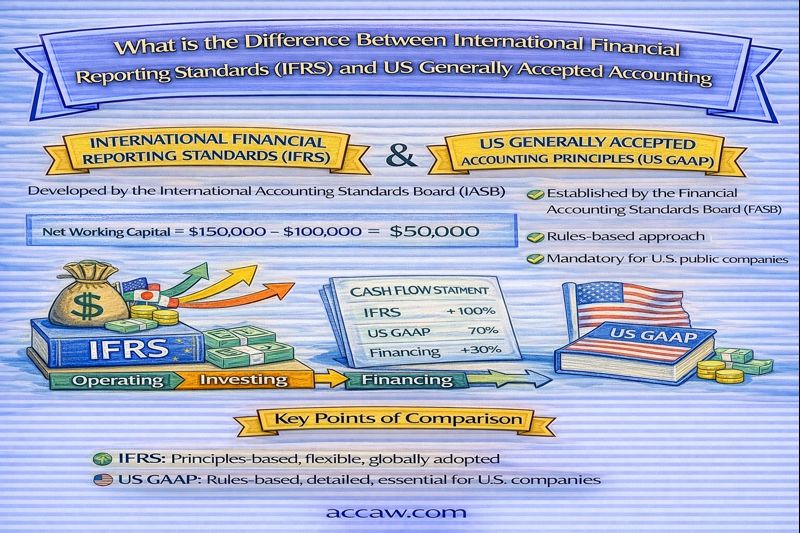
What is the difference between International Financial Reporting Standards (IFRS) and US Generally Accepted Accounting Principles (US GAAP)?
Summary: IFRS and US GAAP are the two dominant global accounting frameworks. The core difference is their underlying approach: IFRS is principles-based (focusing on the economic substance of transactions with professional judgment), while US GAAP is rules-based (providing detailed, specific guidance). Key differences exist in areas like inventory costing (LIFO prohibition under IFRS), development costs capitalization, inventory write-down reversals, and financial statement presentation. Convergence efforts have reduced but not eliminated major differences.
A Tale of Two Philosophies
As businesses operate globally, understanding these two accounting "languages" is crucial. The choice between IFRS and US GAAP can significantly affect reported earnings, financial position, and key ratios, making comparisons across companies in different jurisdictions challenging without adjustment.
1. Foundational Differences: Philosophy and Scope
| Aspect | IFRS | US GAAP | Implication |
|---|---|---|---|
| Governing Body | International Accounting Standards Board (IASB) | Financial Accounting Standards Board (FASB) | Different standard-setters with different constituencies. |
| Underlying Approach | Principles-based. Provides broad principles and requires professional judgment to reflect economic substance. | Rules-based. Provides detailed, specific rules and bright-line tests to promote consistency and reduce ambiguity. | IFRS may lead to more variation in application; US GAAP aims for comparability through detailed rules. |
| Primary Users | Emphasis on investors and capital providers globally. | Broad focus, but with strong consideration for US capital markets and regulators (SEC). | IFRS statements may be more geared toward investment decisions. |
| Geographic Adoption | Used in over 140 countries, including the EU, UK, Canada, Australia, and most of Asia. | Used primarily in the United States. Public US companies must use it. | A US company comparing itself to a European competitor must reconcile key differences. |
| Document Hierarchy | Relies on the Conceptual Framework as primary guidance when no standard applies. | Has an extensive hierarchy including FASB Statements, EITF consensuses, and SEC guidance. | Under IFRS, accountants have more room to use judgment based on principles. |
Key Conceptual Difference: "Substance Over Form"
IFRS places a stronger emphasis on reflecting the economic reality of a transaction, even if it differs from its legal form. US GAAP also considers substance, but its detailed rules can sometimes lead to a "check-the-box" compliance that may not fully capture economics.
2. Major Specific Differences with Financial Impact
A. Inventory
| Issue | IFRS | US GAAP | Financial Statement Impact |
|---|---|---|---|
| Costing Method (LIFO) | Prohibited. Cannot use Last-In, First-Out. | Permitted. A common method in the US for tax and reporting. | Major impact. In periods of rising prices, LIFO results in higher COGS, lower inventory value, and lower taxable income vs. FIFO or Average Cost. An IFRS company will typically show higher profits and higher inventory than a comparable US LIFO user. |
| Write-downs (Lower of Cost or NRV*) | Reversals Allowed. If the reason for a prior write-down reverses, inventory can be written back up (to original cost). | Reversals Prohibited. Once written down, the new cost basis is permanent. | IFRS can show more volatile inventory values and profits, as write-downs and reversals flow through income. US GAAP is more conservative (permanent impairment). |
*NRV = Net Realizable Value (selling price less costs to complete and sell).
B. Intangible Assets & Research & Development (R&D)
| Issue | IFRS | US GAAP | Financial Statement Impact |
|---|---|---|---|
| Research Costs | Expense as incurred. | Expense as incurred. | No difference. |
| Development Costs | Capitalize (as an intangible asset) if strict criteria are met (technical feasibility, intent to complete, ability to use/sell, etc.). | Expense as incurred (with limited exceptions for software). | Major difference. An IFRS tech or pharma company can capitalize development costs, showing higher assets and higher profits initially (as expense is deferred). US GAAP companies expense immediately, resulting in lower profits but higher cash flow from operations (as the cost is a cash outflow with no add-back). |
| Internally Generated Intangibles (Goodwill, Brands) | Generally not recognized as an asset. Expensed as incurred. | Same principle: not recognized. | No difference. |
C. Property, Plant & Equipment (PP&E) and Revaluation
| Issue | IFRS | US GAAP | Financial Statement Impact |
|---|---|---|---|
| Revaluation Model | Permitted. Companies can choose to revalue PP&E to fair value periodically. Increases go to equity (Revaluation Surplus); decreases hit profit. | Prohibited. PP&E must be held at historical cost less accumulated depreciation. | IFRS allows companies in asset-heavy industries (real estate, mining) to show current market values on the balance sheet, increasing equity. US GAAP balance sheets may significantly understate the market value of long-held assets. |
| Component Depreciation | Required. Significant parts of an asset with different useful lives must be depreciated separately. | Allowed but not strictly required. Often applied less granularly. | IFRS leads to more accurate depreciation expense matching the consumption of each part. |
D. Leases
Note: Recent standards (IFRS 16 and ASC 842) have largely converged, requiring lessees to recognize most leases on the balance sheet as a "Right-of-Use" asset and lease liability. Minor differences remain in definition, exemption thresholds, and presentation.
E. Impairment of Long-Lived Assets (Including Goodwill)
| Issue | IFRS | US GAAP | Financial Statement Impact |
|---|---|---|---|
| Impairment Test Trigger | When there is an indication of impairment (annual test required for intangibles with indefinite lives and goodwill). | For goodwill, annual test required (or more frequent if triggering events occur). For other assets, only if triggering events occur. | IFRS may lead to more frequent impairment tests for non-goodwill assets. |
| Impairment Calculation & Reversal | Compare carrying amount to recoverable amount (higher of value in use or fair value less costs to sell). Reversals of impairments (except goodwill) are permitted. | Compare carrying amount to undiscounted future cash flows first; if impaired, measure loss as difference between carrying amount and fair value. Reversals are prohibited. | Major difference. IFRS uses a higher threshold (recoverable amount) and allows reversals, leading to potential earnings volatility. US GAAP uses a lower threshold (undiscounted cash flows) and prohibits reversals, leading to more conservative, permanent write-downs. |
3. Presentation and Disclosure Differences
A. Income Statement (Statement of Comprehensive Income)
| Issue | IFRS | US GAAP |
|---|---|---|
| Format Flexibility | Can present by function (COGS, SG&A) or by nature (materials, labor, depreciation). Must show minimum line items. | Typically presented by function. SEC has specific requirements for public companies. |
| Extraordinary Items | Prohibited. All items are included in profit from ordinary activities. | Eliminated in 2015. No longer a separate category. |
| Discontinued Operations | Definition is broader (a "component" that has been disposed of or is held for sale). | Definition is slightly narrower. |
B. Balance Sheet (Statement of Financial Position)
- IFRS: No prescribed order. Often shows Non-current assets before Current assets.
- US GAAP: Typically lists assets and liabilities in order of liquidity (Current assets first).
C. Statement of Cash Flows
| Issue | IFRS | US GAAP |
|---|---|---|
| Interest & Dividends Paid | Can be classified as either Operating or Financing (choice). | Interest paid: Operating. Dividends paid: Financing. |
| Interest & Dividends Received | Can be classified as either Operating or Investing (choice). | Interest received: Operating. Dividends received: Operating. |
| Bank Overdrafts | Treated as part of Cash and Cash Equivalents. | Treated as a Financing activity (short-term borrowing). |
D. Terminology and Definitions
- "Inventory" vs. "Stock": IFRS uses "Inventory," US GAAP uses "Inventory."
- "Property, Plant and Equipment" (IFRS) vs. "Fixed Assets" or "Property and Equipment" (US GAAP).
- "Share Capital" (IFRS) vs. "Common Stock" (US GAAP).
While minor, these differences highlight the separate evolutions of the frameworks.
4. Practical Implications and Convergence
Impact on Financial Analysis
- Comparability Challenge: An analyst comparing a German (IFRS) and a US (GAAP) automaker must adjust for differences in development cost capitalization, inventory costing, and potential asset revaluations to make a fair comparison of profitability (ROA, margins) and leverage.
- M&A and Cross-Listing: Companies involved in cross-border mergers or listed on multiple exchanges (e.g., a Chinese company listed in Hong Kong (IFRS) and the US) must reconcile their financials or prepare dual reports.
- Performance Metrics: Executive compensation tied to GAAP earnings can be significantly affected by the choice of framework.
The Convergence Project: A Work in Progress
The IASB and FASB have worked for years on a convergence project to align standards. While major successes include revenue recognition (IFRS 15 / ASC 606), leases (IFRS 16 / ASC 842), and financial instruments (partial), full convergence is unlikely in the near future due to philosophical differences, legal environments, and political considerations.
What to Do as an Analyst or Investor?
- Identify the Framework: Always note which framework a company uses (stated in the first footnote).
- Focus on Key Adjustments: For critical comparisons, estimate the impact of major differences (LIFO reserves, capitalized development).
- Use Non-GAAP Measures Carefully: Companies often provide "adjusted" or "non-GAAP" earnings that attempt to normalize differences, but these require scrutiny.
- Read the Reconciliation: Foreign companies listed in the US (through ADRs) file a Form 20-F, which includes a reconciliation of IFRS results to US GAAP. This is a goldmine for understanding the quantitative impact of differences.
5. Summary Comparison Table of Key Differences
| Accounting Area | IFRS | US GAAP | Key Impact |
|---|---|---|---|
| Philosophy | Principles-based | Rules-based | IFRS requires more judgment; US GAAP more detailed guidance. |
| Inventory - LIFO | Prohibited | Allowed | US companies using LIFO show lower profits in inflation. |
| Inventory Write-downs | Reversals allowed | Reversals prohibited | IFRS earnings more volatile from inventory value changes. |
| Development Costs | Capitalize if criteria met | Expense (except software) | IFRS shows higher assets/profits for R&D-heavy firms. |
| PP&E Revaluation | Allowed (fair value model) | Prohibited (cost model only) | IFRS balance sheets can reflect current market values. |
| Impairment Reversals (PP&E) | Allowed (except goodwill) | Prohibited | US GAAP impairments are "one-way streets." |
| Cash Flow - Interest Paid | Operating or Financing | Operating | Affects operating cash flow comparison. |
| Extraordinary Items | No concept | Eliminated (was separate) | No major difference today. |
| Leases (Lessee) | Most on balance sheet (IFRS 16) | Most on balance sheet (ASC 842) | Largely converged. |
| Revenue Recognition | 5-step model (IFRS 15) | 5-step model (ASC 606) | Largely converged. |
Conclusion: Navigating a Dual-System World
While convergence has narrowed the gap in some areas, significant philosophical and specific differences between IFRS and US GAAP persist. For the foreseeable future, financial statement users must be bilingual.
For preparers and auditors, the choice dictates the set of rules to follow.
For analysts and investors, understanding these differences is not an academic exercise—it is essential for making accurate comparisons, valuing companies, and assessing risk across global markets. The most prudent approach is to dig into the footnotes, understand the major adjustments, and always frame analysis within the context of the applicable accounting framework.
In a globalized economy, accounting literacy means understanding both IFRS and US GAAP.