
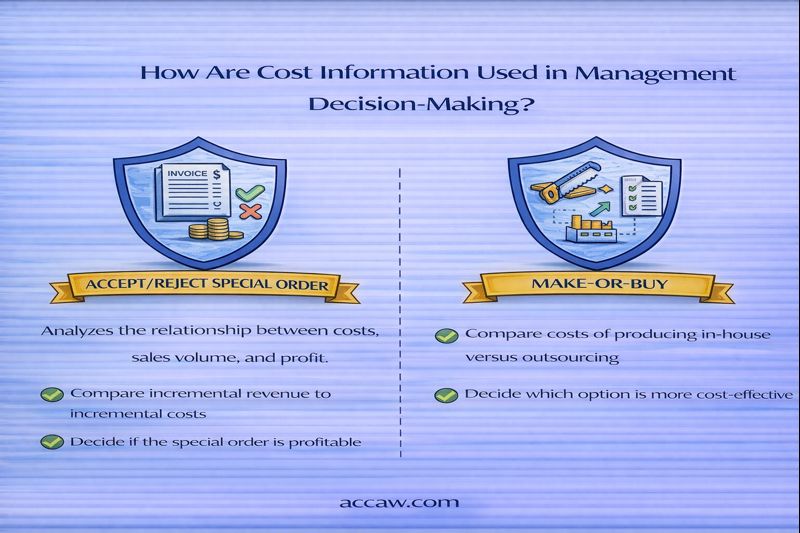
Cost information supports decisions like special orders (consider incremental costs/revenues) and make-or-buy (compare relevant costs). Focus on relevant costs that differ between alternatives.

Cost Information in Management Decisions

Cost information helps managers make decisions by analyzing relevant costs - those that differ between alternatives. Two key decisions are special orders and make-or-buy choices.

Key Concepts:

  • Relevant Costs: Future costs that differ between alternatives
  • Irrelevant Costs: Costs that are the same for all alternatives
  • Sunk Costs: Past costs that cannot be changed - always irrelevant
  • Opportunity Costs: Benefits foregone by choosing one alternative

How are cost information used in management decision-making (accept/reject a special order, make-or-buy)?

Summary: Cost information is crucial for short-term, non-routine management decisions like special orders and make-or-buy choices. The key is to focus on relevant costs and revenues—future costs that differ between alternatives. Irrelevant costs (sunk costs, unavoidable fixed costs) are ignored. For a special order, accept if incremental revenue > incremental costs. For make-or-buy, compare the relevant cost to make with the purchase price to buy.

The Art of Choosing: Relevant Costs for Specific Decisions

Not all costs matter when making a specific decision. Managerial decision-making separates the signal from the noise by identifying which costs will actually change based on the choice. This prevents falling into common traps like considering sunk costs or misallocated overhead.

1. Special Order Decisions

Deciding whether to accept a one-time order at a lower than normal price.

Decision Rule:

Accept if: Incremental Revenue > Incremental Costs

Relevant Costs for Special Orders:

  1. Direct Materials: Additional materials needed
  2. Direct Labor: Additional labor if required
  3. Variable Overhead: Additional variable costs
  4. Any Special Costs: Setup, shipping, commissions

Irrelevant Costs:

  • Fixed overhead (unless increases)
  • Sunk costs
  • Regular selling expenses (if order doesn't affect them)

Example:

  • Normal price: $100 per unit
  • Special order price: $70 per unit
  • Variable cost per unit: $50
  • Incremental revenue: $70
  • Incremental cost: $50
  • Decision: Accept (contributes $20 per unit to fixed costs)

1. The Foundation: Relevant Costs & Revenues

What Makes a Cost "Relevant"?

A relevant cost/revenue has two characteristics:

  1. It is a future cost/revenue (not a sunk cost).
  2. It differs between the alternatives being considered.

Types of Costs and Their Relevance

Cost TypeDefinitionRelevance in Decision-MakingExample
Relevant (Differential/Incremental) Cost A future cost that differs between alternatives. CRITICAL – Include in analysis. Direct materials for a special order; extra freight for an external supplier.
Sunk Cost A cost already incurred and cannot be changed. IRRELEVANT – Ignore completely. Depreciation on already-owned equipment; past R&D expenses.
Avoidable vs. Unavoidable Fixed Cost A fixed cost that can be eliminated if an activity is discontinued (avoidable) vs. one that cannot (unavoidable). Avoidable: RELEVANT.
Unavoidable: IRRELEVANT.
If closing a department, the department manager's salary is avoidable; allocated corporate rent may be unavoidable.
Opportunity Cost The benefit foregone by choosing one alternative over another. RELEVANT – Include as a cost of the chosen alternative. Using idle machine capacity for a special order has $0 opportunity cost. Using capacity that could be rented out has an opportunity cost equal to the rent foregone.

Golden Rule: In decision-making, compare the future, incremental cash flows of each alternative.

2. Decision 1: Accept or Reject a Special Order

The Scenario

A company receives a one-time offer to sell its product at a lower-than-usual price, often in large quantity. The key question: "Will this order increase our total net income, even at a lower price?"

Decision Rule

Accept the Special Order IF:
Incremental Revenue from Order > Incremental Costs from Fulfilling the Order

Key Considerations

  • Idle Capacity is Crucial: The analysis assumes the company has sufficient idle capacity to produce the order without affecting regular sales. If accepting the order requires sacrificing regular sales, the lost contribution margin from those regular sales is an opportunity cost that must be included.
  • Relevant Costs Typically Include: Direct materials, direct labor, variable manufacturing overhead, any special costs (e.g., unique packaging, extra shipping).
  • Irrelevant Costs Typically Include: Fixed manufacturing overhead (if it won't increase), sunk costs, allocated costs.
  • Qualitative Factors: Will this low price anger regular customers? (Cannibalization). Is this a strategic entry into a new market?

Example: Special Order Analysis

Regular Data: Selling price: $50/unit. Unit cost: DM $15, DL $10, Variable MOH $5, Fixed MOH $8 (allocated).
Special Order: 5,000 units @ $30/unit. Requires a special logo costing $1/unit. Company has plenty of idle capacity.

Incremental Revenue: 5,000 × $30 = $150,000
Incremental Costs:
  Direct Materials: 5,000 × $15 = $75,000
  Direct Labor: 5,000 × $10 = $50,000
  Variable MOH: 5,000 × $5 = $25,000
  Special Logo: 5,000 × $1 = $5,000
  Total Incremental Costs = $155,000
Incremental Net Income = $150,000 - $155,000 = ($5,000)

Decision: REJECT. The order would decrease total net income by $5,000. Notice we ignored the fixed MOH of $8/unit because it is unaffected by the order (an irrelevant, unavoidable fixed cost).

2. Make-or-Buy Decisions

Deciding whether to produce a component internally or purchase from supplier.

Decision Rule:

Buy if: Purchase Cost < Relevant Costs to Make

Relevant Costs to Make:

  1. Direct Materials: Materials used in production
  2. Direct Labor: Labor specifically for the component
  3. Variable Overhead: Additional variable costs
  4. Avoidable Fixed Costs: Fixed costs that can be eliminated if buy

Irrelevant Costs:

  • Unavoidable fixed costs (allocated overhead)
  • Sunk costs (equipment already purchased)
  • Non-cash expenses (depreciation on existing equipment)

Example:

  • Cost to make per unit:
    - Direct materials: $15
    - Direct labor: $10
    - Variable overhead: $5
    - Avoidable fixed: $3
    - Unavoidable fixed: $7 (allocated)
    Total relevant cost: $33
  • Purchase price from supplier: $35 per unit
  • Decision: Make internally (saves $2 per unit)

Important Considerations:

  1. Consider quality differences between make and buy
  2. Evaluate supplier reliability
  3. Consider impact on employees if outsourcing
  4. Analyze long-term vs short-term implications
  5. Review capacity utilization - use idle capacity if available
  6. Consider opportunity costs of using facilities for other purposes

Other Decisions Using Cost Information:

  • Product Mix: Choose products with highest contribution margin per constrained resource
  • Keep or Drop: Compare lost contribution margin with avoidable fixed costs
  • Sell or Process Further: Compare additional revenue with additional processing costs

3. Decision 2: Make-or-Buy (Outsourcing)

The Scenario

A company must decide whether to produce a component internally or purchase it from an external supplier. This is also known as an outsourcing decision.

Decision Rule

Buy IF: Purchase Price < Relevant Cost to Make
Make IF: Relevant Cost to Make < Purchase Price

Calculating the Relevant Cost to Make

This includes all future costs that will be avoided if the part is bought instead of made.

  • Include: Direct materials, direct labor, variable overhead, any avoidable fixed overhead (e.g., supervisor salary saved, equipment lease cancelled).
  • Exclude: Unavoidable fixed overhead (allocated costs that will continue regardless of the decision), sunk costs.
  • Consider Opportunity Costs: If the freed-up resources (space, labor, machinery) can be used for another profitable purpose, the benefit from that alternative use is an opportunity cost of making (or an added benefit of buying).

Example: Make-or-Buy Analysis

Current Cost to Make 10,000 units: DM $4, DL $6, Variable MOH $3, Fixed MOH (allocated) $5, Total $18/unit.
Supplier Quote: $15/unit.
Additional Info: 40% of the fixed MOH ($2/unit) is avoidable (related to equipment that could be sold). The remaining 60% ($3/unit) is unavoidable (allocated corporate costs). If bought, the freed-up space could be rented for $12,000/year.

Relevant Cost to Make (per unit):
  Direct Materials: $4
  Direct Labor: $6
  Variable MOH: $3
  Avoidable Fixed MOH: $2
  Total Avoidable Cost per unit = $15
Total Relevant Cost to Make (10,000 units) = 10,000 × $15 = $150,000

Cost to Buy:
  Purchase Price: 10,000 × $15 = $150,000
  MINUS: Opportunity Benefit (Rental Income) = ($12,000)
  Net Cost to Buy = $138,000

Comparison:
  Make: $150,000
  Buy: $138,000
Difference in Favor of Buying = $12,000

Decision: BUY. The net cost to buy is $12,000 lower. The opportunity benefit (rental income) tipped the scales. Note: The unavoidable fixed overhead of $3/unit ($30,000 total) was ignored—it is a sunk/common cost that will be incurred either way.

4. Other Common Short-Term Decisions Using Relevant Costs

A. Sell or Process Further (Joint Products)

After a split-off point, should a product be sold as-is or processed further?

Process Further IF: Incremental Revenue from Further Processing > Incremental Costs of Further Processing
Ignore: Joint costs incurred before the split-off point (they are sunk).

B. Product Line Discontinuation

Should an unprofitable product line be dropped?

Drop the Line IF: Lost Contribution Margin from the Line < Avoidable Fixed Costs of the Line
(If dropping the line eliminates more fixed costs than it loses in contribution margin, net income increases).
Beware: Often, many "fixed" costs allocated to a product line (like factory rent) are unavoidable and will continue even if the line is dropped. Only avoidable fixed costs are relevant.

C. Optimal Use of a Constrained Resource (Machine Hours, Labor)

When capacity is limited, which products should be prioritized?

Maximize: Contribution Margin per Unit of the Constrained Resource
= (Contribution Margin per Unit) / (Units of Constrained Resource Required per Unit)
Produce products with the highest CM per constrained resource first.

5. Step-by-Step Framework for Any Decision

  1. Define the Alternatives: What are the specific choices? (e.g., Accept Order vs. Reject; Make vs. Buy).
  2. Identify All Future Costs and Revenues that Differ: List cash flows for each alternative. Ignore sunk costs and allocated/common costs.
  3. Include Opportunity Costs: What is the best alternative use of resources freed up?
  4. Calculate the Net Financial Impact for each alternative.
  5. Consider Qualitative Factors: Quality control, supplier reliability, employee morale, strategic fit, customer relationships.
  6. Make a Recommendation based on the quantitative and qualitative analysis.

6. Common Pitfalls to Avoid

  • The Sunk Cost Fallacy: "We've already spent so much on this project, we have to continue." No—only future costs matter.
  • Misusing Full Absorption Cost: Including allocated fixed overhead in unit costs for decision-making (e.g., rejecting a special order because price < "full cost").
  • Ignoring Opportunity Costs: Overlooking the value of alternative uses for resources.
  • Assuming All Fixed Costs are Avoidable: Many are not and will be incurred regardless of the decision.

Conclusion: The Power of Relevant Analysis

Effective managerial decision-making hinges on the disciplined use of relevant cost analysis. By filtering out accounting noise and focusing solely on costs and revenues that differ between choices, managers can make economically rational decisions that enhance profitability. Whether evaluating a special order, an outsourcing opportunity, or a product line, the principles remain the same: follow the incremental cash flows and ignore the sunk costs. This approach turns cost accounting data into a powerful tool for steering the business toward better financial outcomes.

Share this page: Twitter Facebook LinkedIn