
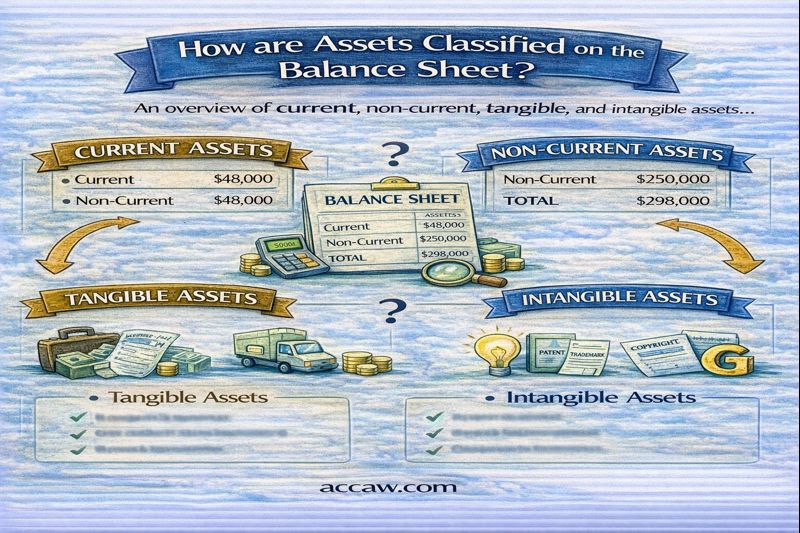
Assets are classified as current/non-current based on liquidity and tangible/intangible based on physical existence, providing useful information about a company's financial position.

Asset Classification on Balance Sheet

Assets are classified on the balance sheet to provide useful information about a company's financial position, liquidity, and resource composition.

Two Main Classification Methods:

  1. By Liquidity: Current vs Non-current Assets
  2. By Physical Nature: Tangible vs Intangible Assets

Importance of Classification:

  • Shows liquidity position
  • Helps assess financial health
  • Required by accounting standards
  • Aids in ratio analysis

1. Classification by Liquidity

Current Assets:

Assets expected to be converted to cash or used within one year or operating cycle.

  • Criteria: Cash, or convertible to cash within 12 months
  • Order of Liquidity: Listed from most to least liquid
  • Examples:
    1. Cash and cash equivalents
    2. Short-term investments
    3. Accounts receivable
    4. Inventory
    5. Prepaid expenses

Non-Current Assets:

Assets held for long-term use (more than one year).

  • Also Called: Fixed assets, long-term assets
  • Purpose: Used in operations, not for resale
  • Examples:
    1. Property, Plant & Equipment (PPE)
    2. Long-term investments
    3. Intangible assets
    4. Goodwill
    5. Deferred tax assets

Balance Sheet Presentation:

Current AssetsAmountNon-Current AssetsAmount
Cash$50,000Property, Plant & Equipment$500,000
Accounts Receivable$100,000Less: Accumulated Depreciation($100,000)
Inventory$150,000Net PPE$400,000
Prepaid Expenses$20,000Intangible Assets$80,000
Total Current Assets$320,000Long-term Investments$50,000
Total Non-Current Assets$530,000
TOTAL ASSETS$850,000

2. Classification by Physical Nature

Tangible Assets:

Physical assets that can be touched and seen.

  • Characteristics: Physical substance, depreciable
  • Examples:
    1. Land
    2. Buildings
    3. Machinery & Equipment
    4. Vehicles
    5. Furniture & Fixtures
  • Accounting: Depreciated (except land)

Intangible Assets:

Non-physical assets without physical substance.

  • Characteristics: No physical form, identifiable
  • Examples:
    1. Patents
    2. Trademarks
    3. Copyrights
    4. Software
    5. Goodwill (unidentifiable intangible)
  • Accounting: Amortized (finite life) or impairment tested (indefinite life)

Special Categories:

Property, Plant & Equipment (PPE):

  • Tangible assets used in operations
  • Presented at cost less accumulated depreciation
  • Disclose separately: Land, Buildings, Equipment

Financial Assets:

  • Investments in securities
  • Classified as: Trading, Available-for-sale, or Held-to-maturity
  • Current vs non-current based on holding period

Other Assets:

  • Deferred tax assets
  • Prepaid expenses (long-term portion)
  • Security deposits

Key Accounting Standards:

  1. IAS 1: Requires current/non-current classification
  2. IAS 16: Property, Plant and Equipment
  3. IAS 38: Intangible Assets
  4. IAS 36: Impairment of Assets

Important Considerations:

  1. Materiality: Significant items disclosed separately
  2. Consistency: Same classification method each period
  3. Judgment: Some assets may be current or non-current depending on use
  4. Disclosures: Must disclose basis of classification
  5. Reclassification: If asset's use changes, may need to reclassify

Financial Analysis Implications:

Current Ratio Analysis:

Current Ratio = Current Assets ÷ Current Liabilities

  • Higher ratio indicates better short-term liquidity
  • Industry norms vary (retail vs manufacturing)

Asset Turnover Ratios:

  • Total Asset Turnover: Sales ÷ Total Assets
  • Fixed Asset Turnover: Sales ÷ Net Fixed Assets
  • Measures efficiency of asset use

Capital Structure Analysis:

  • Proportion of fixed vs current assets
  • High fixed assets may indicate capital-intensive business
  • Intangible-heavy companies may have different risk profiles

Common Classification Challenges:

  1. Inventory: May be long-term if held for sale beyond one year
  2. Prepaid Expenses: Split between current and non-current portions
  3. Investments: Classification depends on management intent
  4. Assets Held for Sale: Separate category with special rules
  5. Leased Assets: Right-of-use assets under IFRS 16

Best Practices for Asset Classification:

  1. Establish clear classification policies
  2. Regularly review asset useful lives
  3. Document rationale for classification decisions
  4. Ensure consistency across reporting periods
  5. Train accounting staff on classification rules
  6. Review industry practices for comparability

Practical Example - Manufacturing Company:

  • Current Assets:
    • Cash: $100,000
    • Raw Materials: $50,000
    • Work-in-Progress: $30,000
    • Finished Goods: $70,000
    • Accounts Receivable: $150,000
  • Non-Current Assets:
    • Land: $200,000
    • Factory Building: $500,000
    • Machinery: $300,000
    • Patents: $100,000
    • Goodwill: $50,000

Key Takeaways:

  1. Classification provides vital information about liquidity and asset composition
  2. Must follow accounting standards (IFRS/GAAP) requirements
  3. Affects financial ratios and analysis
  4. Requires professional judgment for certain assets
  5. Proper classification enhances financial statement usefulness
  6. Regular review and updates needed as business changes
Share this page: Twitter Facebook LinkedIn