
What is Activity-Based Costing (ABC)?
Activity-Based Costing
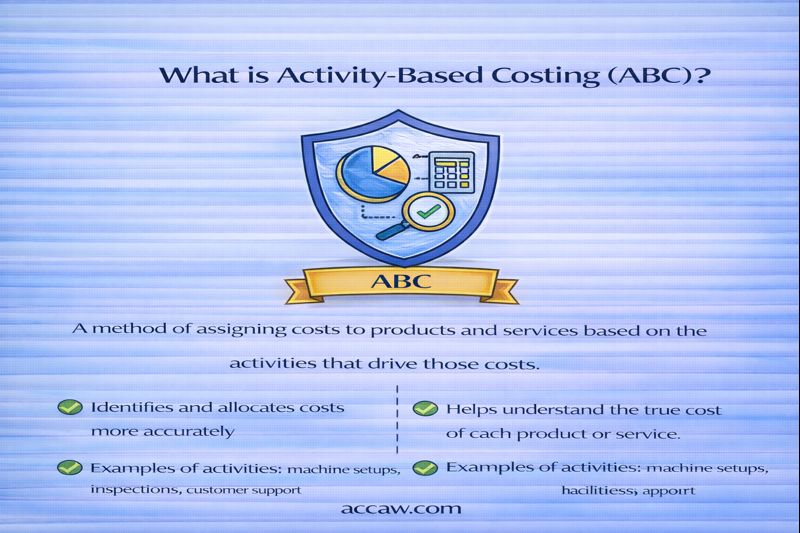
What is Activity-Based Costing (ABC)?
Summary: Activity-Based Costing (ABC) is a costing method that allocates overhead and indirect costs to products based on the activities they require and the resources those activities consume. It identifies cost drivers (activities that cause costs) and assigns costs to products proportionally to the product's consumption of each activity. ABC provides more accurate product costs than traditional volume-based methods, especially in complex, multi-product environments with diverse overhead demands.
Moving Beyond Simple Averaging
Traditional costing often distorts costs by averaging overhead across all products based on a single volume measure (like labor hours). ABC recognizes that not all overhead costs are driven by production volume. Some products cause overhead costs by requiring more setups, inspections, or design changes, regardless of how many units are made.
1. The Problem with Traditional Costing
In a multi-product company, traditional costing can lead to cost cross-subsidization: • High-volume, simple products are overcosted (assigned more than their fair share of overhead). • Low-volume, complex products are undercosted (assigned less than their fair share). This leads to poor pricing, profitability analysis, and strategic decisions.
2. The ABC Approach: A Multi-Stage Process
Step 1: Identify Activities
Analyze all the tasks performed that consume resources. Examples: Machine setup, quality inspection, purchasing, production orders, design engineering, customer service.
Step 2: Assign Resource Costs to Activities (Create Activity Cost Pools)
Trace or allocate overhead costs (salaries, supplies, depreciation) to the activities they support. This creates an Activity Cost Pool for each major activity (e.g., a "Setup Cost Pool").
Step 3: Identify Cost Drivers for Each Activity
A Cost Driver is a factor that causes the cost of an activity to change. It should be measurable and have a cause-and-effect relationship. • Setup Activity → Cost Driver: Number of Setup Hours (or Number of Setups). • Inspection Activity → Cost Driver: Number of Inspections. • Purchasing Activity → Cost Driver: Number of Purchase Orders.
Step 4: Calculate Activity Rates
Activity Rate = Total Cost in Activity Cost Pool / Total Cost Driver Units
Example: Total Setup Costs = $100,000. Total Setup Hours = 500.
Setup Rate = $100,000 / 500 hours = $200 per setup hour.
Step 5: Assign Costs to Cost Objects (Products, Services, Customers)
For each product, multiply the activity rate by the quantity of the cost driver the product consumes.
Product A requires 2 setup hours.
Setup Cost assigned to Product A = 2 hours × $200/hour = $400.
Repeat for all activities and sum to get total overhead cost for the product.
3. Illustrative Example: Simple vs. Complex Product
Company Data: Total Overhead: $1,000,000. Two products: Standard (high-volume, simple) and Custom (low-volume, complex).
| Activity (Cost Pool) | Total Cost | Cost Driver | Total Driver Vol. | Activity Rate | Standard (10,000 units) | Custom (100 units) |
|---|---|---|---|---|---|---|
| Machine Runs | $600,000 | Machine Hrs | 60,000 hrs | $10/hr | 50,000 hrs ($500k) | 10,000 hrs ($100k) |
| Setups | $300,000 | # of Setups | 150 setups | $2,000/setup | 50 setups ($100k) | 100 setups ($200k) |
| Design Changes | $100,000 | # of Changes | 50 changes | $2,000/change | 10 changes ($20k) | 40 changes ($80k) |
| Total Overhead Assigned | $1,000,000 | $620,000 | $380,000 | |||
| Overhead per Unit | $62.00 | $3,800.00 |
Under Traditional (Machine Hour) Costing: Rate = $1,000,000 / 60,000 hrs = $16.67/hr.
Standard: 50,000 hrs × $16.67 = $833,500 ($83.35/unit). Overcosted by $21.35/unit.
Custom: 10,000 hrs × $16.67 = $166,700 ($1,667/unit). Undercosted by $2,133/unit!
ABC reveals the Custom product is far more expensive to produce than the traditional system suggested.
4. Benefits and Limitations of ABC
Benefits:
- More Accurate Product Costs: Leads to better pricing and profitability analysis.
- Identifies Costly Activities: Highlights non-value-added activities for process improvement (Activity-Based Management - ABM).
- Better Decision-Making: Supports "make vs. buy," product mix, and customer profitability analysis.
Limitations:
- Costly and Complex to Implement/Maintain: Requires significant data collection and analysis.
- Subjectivity: In identifying activities and cost drivers.
- Not Universally Needed: May be overkill for simple, single-product companies.
5. Conclusion: A Strategic Costing Tool
ABC is more than an accounting exercise; it's a strategic management tool that provides deep insights into the economics of a business. By linking costs to the activities that drive them, ABC uncovers the true cost and profitability of products, services, and customers, enabling managers to make decisions that enhance long-term value.